
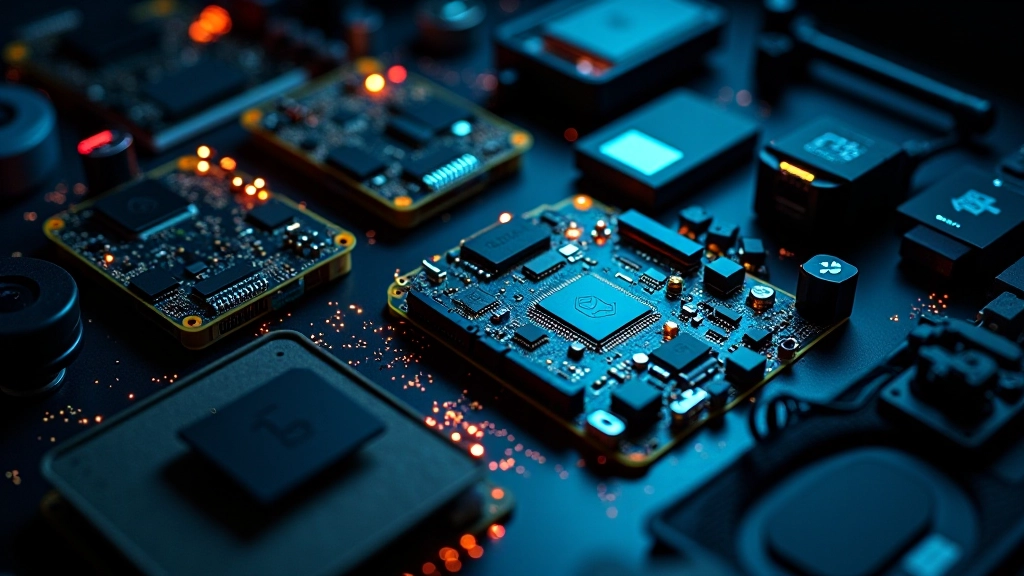
Hardware Selection for Ottawa Startups
A practical comparison of NVIDIA Jetson, ARM processors, and Intel options. Includes cost, power, and performance considerations.
Learn how to reduce model size by 80% without losing accuracy. Covers post-training and quantization-aware training approaches.
Mobile devices have limited memory and compute power. If you're deploying neural networks on phones, tablets, or edge devices, you've hit this problem already. Your model works great on your server—but it won't fit on a device, or it drains the battery in minutes.
Quantization solves this. It's one of the most practical techniques for edge AI, and it's not complicated once you understand the core idea. Instead of storing weights and activations as 32-bit floats, you use lower precision numbers—usually 8-bit integers. The math stays essentially the same, but the model gets smaller, faster, and more power-efficient.

Post-training quantization is the easiest starting point. You've already trained your model. Now you just convert it. TensorFlow Lite, ONNX, and CoreML all support this out of the box.
Here's what happens: the framework analyzes your trained weights and activations, then converts them to lower precision. You don't need to retrain anything. In most cases, you'll see 3-4x size reduction with minimal accuracy loss.


Post-training quantization works, but it's not optimal. You're quantizing a model that was never trained to be quantized. Sometimes accuracy drops more than you'd like.
Quantization-aware training (QAT) is different. During training, you simulate quantization. The model learns to work well even at lower precision. This means better accuracy at the same model size, or smaller models at the same accuracy.
"QAT takes longer to train, but you get models that actually perform well on mobile devices. It's worth the extra effort if accuracy matters to you."
This article provides general information about quantization techniques and their typical results. Actual performance depends on your specific model architecture, hardware target, and use case. Always test quantization on your target device. Accuracy, speed, and size improvements vary significantly based on model design and quantization parameters.
Which approach should you use? It depends on your constraints.

Measure your model's current size, inference latency, and accuracy on your target device. You'll need these numbers to compare against quantized versions.
Use TensorFlow Lite converter or ONNX quantizer. Takes 30 minutes. See if accuracy loss is acceptable for your use case.
Don't trust desktop benchmarks. Deploy to your target device. Measure real inference time, memory usage, and battery impact.
If accuracy drop is too high, go back and retrain with quantization-aware training. Use TensorFlow Model Optimization Toolkit or PyTorch's quantization APIs.

Editorial Team
Written by the LatencyLabs editorial team, focused on clear, practical guidance for edge AI deployment.
A practical comparison of NVIDIA Jetson, ARM processors, and Intel options. Includes cost, power, and performance considerations.

Which framework should you choose? We break down deployment complexity, model compatibility, and performance differences.

End-to-end walkthrough of a production edge system. Covers data collection, model deployment, and latency optimization.